
Enigma Magic Mushrooms | enigma magic mushroom strain | enigma mushroom trip | enigma mushroom spore
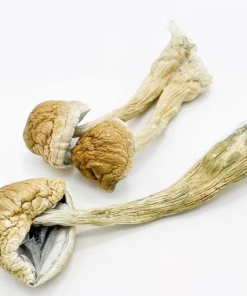
Buy Enigma Magic Mushrooms online, Enigma Magic Mushrooms in Australia are a rare and highly sought-after Psilocybe cubensis strain known for their unique “blob-like” growth pattern and exceptional potency. These mushrooms provide a deep, introspective journey with vibrant visuals and euphoric sensations. Perfect for experienced psychonauts seeking a powerful and unforgettable experience.
Dosage Recommendations
Microdose: 0.1g to 0.3g for enhanced creativity, focus, and mood.
Moderate Dose: 1g to 2g for light visuals and a mildly psychedelic journey.
Heroic Dose: 3g+ for a deep, immersive, and transformative experience.
Where it begins to get really interesting, is when you start to remove the veil and see the long-lasting impression that fungi have really imprinted on Earth, from its billion-year-old infancy to present day. The internet, which we know as the “World Wide Web” as well as the human brain, both mimic the mycelial networks of mushrooms that reside underground which bind and feed all of the Earth’s soil.
For example, hyphae combine every few millimetres via clamp connections to form a mycelium – very similar to neural connections within the brain. The mushroom and the brain both share similarities in their growth and morphogenesis, in addition to the growth and structure of the internet. One may be aware of the poisonous treachery of a death cap, or the culinary delicacy that a Shiitake mushroom provides, but there is also another dimension that mushrooms offer us in Psilocybin.
Order Enigma Magic Mushrooms near me Perth | how to grow enigma mushroom | enigma mushroom dosage
A mushroom is the fleshy, fruiting body of a fungus, and while they may be the most commonly known members of the fungal kingdom – that is not really the whole story. The fruiting bodies are made up of a huge network of underground, thin, interconnected threads of mycelium. A mycelium is the vegetative form of a fungus, which arises from the germination of two compatible spores to form a filamentous cell, called a hypha. Hyphae reproduce through cell division, and if two are compatible with one another they fuse to form a mycelium. As the mycelium expands, it forms a web of cells, known as a mycelial network.
Through this network, the roots of different plants can be interlinked, and the mycelial network enables the distribution of nutrients and information among these organisms. Additionally, it has the ability to deter unwelcome plants by spreading toxic chemicals through the network. Around 90% of all land plants share a mutualistic relationship with fungi through these underground networks.
This relationship is known as a mycorrhizal association, whereby the fungus colonizes the roots of a plant – which boosts the plant’s immune system as the fungi trigger the production of the host plant’s defences, making the plant more resistant to disease. The plant can also provide fungi with a carbohydrate food source and in turn, the fungi assist the plants in the uptake of water. Furthermore, the fungi can provide nutrients such as nitrogen and phosphorus through their mycelia.
| Select Quantity | 1/2 oz, 1 oz, 2 oz, 4 oz |
|---|
Related products

Magic mushrooms Online

Magic mushrooms Online
Magic mushrooms Online
Magic mushrooms Online

Magic mushrooms Online
Magic mushrooms Online

Magic mushrooms Online

Magic mushrooms Online